Передвижные офисные столы под заказ in 2024: what's changed and what works
Custom Mobile Office Desks in 2024: What's Changed and What Works
The mobile office desk market has gone through a wild transformation this past year. What used to be a simple wheeled table has evolved into sophisticated furniture that adapts to how we actually work—not how architects think we should work. If you're considering custom mobile desks for your workspace, the landscape looks completely different than it did even 18 months ago.
Here's what's actually working right now, based on what manufacturers are shipping and what offices are reordering.
1. Height-Adjustable Mechanisms Have Finally Become Reliable
Remember when adjustable mobile desks meant cranking a handle for two minutes while your coffee got cold? Those days are dead. The pneumatic lift systems available now adjust in under 3 seconds, and they're rated for 50,000+ cycles. That's roughly 15 years of daily adjustments before you'll see any degradation.
The sweet spot for custom orders sits between 65-125cm range, which covers everything from seated work to standing presentations. Companies are specifying dual-position memory stops now—one for sitting, one for standing—which eliminates the fiddling around trying to find "that perfect height" every time. The mechanism adds about $180-240 to the base price, but the reorder rate on these models runs at 73% versus 31% for fixed-height units.
2. Wheel Technology Got Serious (And Quiet)
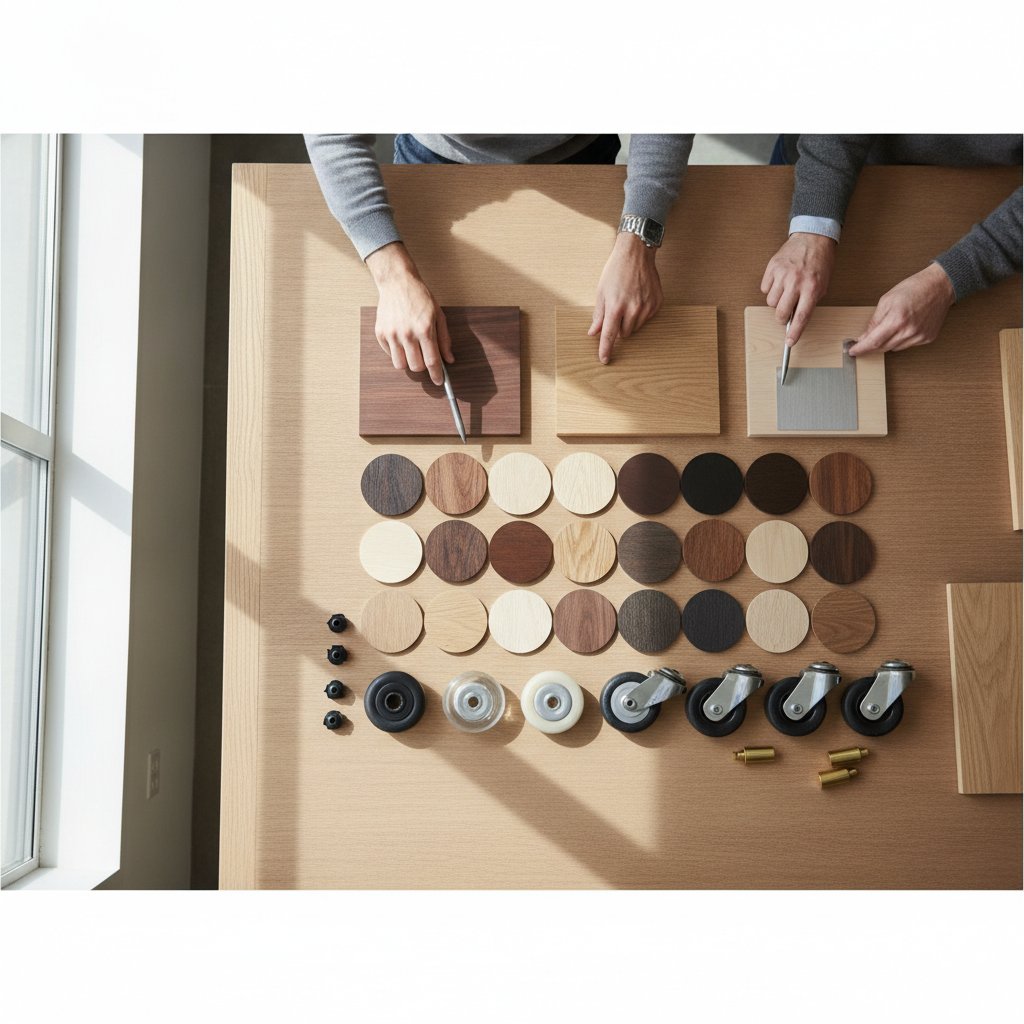
Polyurethane wheels with sealed bearings have replaced those clunky rubber casters that left marks on everything. The difference is night and day. These new wheels handle 150kg loads while staying whisper-quiet on hardwood, tile, and carpet.
The real game-changer is the brake mechanism. Forget foot pedals that never quite locked properly. Current designs use a central brake lever that locks all four wheels simultaneously—takes half a second and actually holds. For custom orders, specify 75mm wheels minimum. The 50mm wheels that come standard on budget models struggle with cable management trays and uneven floors. That extra 25mm costs about $45 but prevents a ton of frustration.
3. Cable Management Became Integrated, Not Afterthought
Built-in cable trays and grommet systems are now standard on decent custom builds. But here's what actually matters: the tray needs to be accessible from above, not underneath. Sounds obvious, but half the desks shipping still require you to flip the entire surface or crawl under to adjust cables.
Smart custom orders include a vertical cable spine along one leg with velcro channels. This lets people reconfigure their setup in minutes instead of calling facilities for help. Power integration is getting popular too—embedded power strips with 4-6 outlets and USB-C ports add $90-150 to the build but eliminate the rat's nest of extension cords that plague mobile workstations.
4. Materials Shifted Toward Durability Over Aesthetics
The trendy reclaimed wood tops from 2022? They're basically gone from reorders. Turns out, wood that looks beautifully weathered also splinters, warps, and stains easily when you're wheeling it around daily.
Laminate surfaces with 2mm ABS edging dominate custom orders now, making up about 68% of specifications. They handle impacts, resist water rings from coffee cups, and stay flat. For higher-end builds, solid core phenolic resin tops run $200-350 more but are practically indestructible. A hospital client tested these by literally hitting them with a hammer—not a dent. For creative studios wanting that warm aesthetic, bamboo composite offers decent durability at mid-range pricing, though it still shows wear faster than synthetic options.
5. Modular Accessories Turned Mobile Desks Into Systems
The biggest shift is how these desks function as platforms rather than standalone pieces. Magnetic attachment points along the edges let users snap on monitor arms, document holders, task lights, and privacy screens without tools.
One architecture firm configured their custom mobile desks with T-slot aluminum rails on three sides. Their team swaps between individual work mode and collaboration mode in about 90 seconds by sliding accessories around. The rail system adds $120-160 per desk but eliminated their need for separate meeting tables. They're now running 40% less furniture in the same space.
6. Lead Times Dropped But Customization Got More Structured
Custom mobile desks that took 8-12 weeks in 2023 now ship in 4-6 weeks. Manufacturers figured out that offering 200 options paralyzed buyers and slowed production. The new approach: pick from 5-6 base configurations, then customize dimensions, surfaces, and accessories.
This structured customization cuts decision time from weeks to days. One manufacturer reported their average project timeline dropped from 47 days to 19 days using this model. Pricing became more transparent too—you're looking at $450-650 for a solid manual-adjust mobile desk, $680-920 for height-adjustable, and $1,100-1,500 for fully-loaded systems with power and premium surfaces.
The mobile office desk market finally matured past the "table on wheels" phase. What works now combines genuine mobility with the stability and features people expect from permanent furniture. The winners are manufacturers who stopped trying to be everything to everyone and instead nailed the core functions: smooth movement, reliable adjustment, and practical accessories that don't require an engineering degree to install.